


Calrec Summa (New)
Price via quote
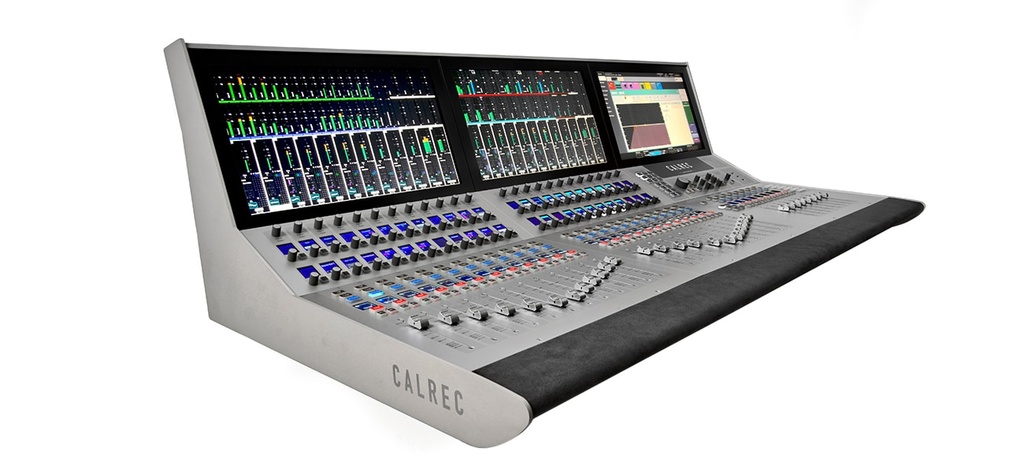
Calrec Summa physical control surface. Available in fixed 12+8, 24+8 and 36+8 fader configurations
Select Condition

Calrec Summa (New)
The elegant Summa is perfect for broadcasters looking for the power to produce engaging broadcast audio with a clear, open and straightforward interface. Give your creativity some breathing space with Summa’s simplified workflows.
Summa’s considered control simplifies even complex workflow tasks, such as creating mix-minus feeds, but still packs a lot of punch. With 300 DSP processing paths, Summa has eight groups, four mains, 16 auxes, and 32 tracks. Its router is the same technology as the larger Apollo and Artemis consoles.
Summa can connect directly to an existing IP network via Calrec’s AoIP unit.
At the heart of Summa's Hydra2 network is the 4096 Calrec router. Networks become more advanced when multiple routers are connected together to add additional mixing consoles, or to increase the amount of I/O connections available. Routers, mixing consoles and I/O can all be easily connected to the network as and when needed.
Features
The physical control surface is available in fixed 12+8, 24+8 and 36+8 fader configurations with a new streamlined layout. Each channel strip has only the most essential mechanical controls, featuring a fader, two flexible control cells, and a dedicated gain control.
Summa’s large displays are fully configurable to display bus, output, and loudness meters, and feature dedicated metering, routing, and processing information per fader.
Ultimate control via a 17-inch multitouch screen inspired by familiar tablet technology, with a straightforward interface that uses established finger gestures to navigate the system. The crisp, high-resolution display provides elegant controls and clear presentation of information.
Surface
100mm faders with PFL overpress
Six surface layers
Built-in talkback microphone
Stereo headphone output
Processing
Up to 300 DSP paths
Up to 180 input channels
4 x main outputs (mono, stereo or 5.1)
8 x audio sub-groups (mono, stereo or 5.1)
32 x track outputs (mono or stereo)
16 x auxiliary outputs (mono or stereo)
1 x direct output per channel (pre EQ, pre fader or post fader)
1 x mix minus output per channel (can be fed from auto minus, auxes, tracks or off Air conference bus)
1 x auto minus bus
1 x off air conference bus
1 x insert on every channel, group, main and console monitor output
152 x external monitor and meter inputs
4 x Automixers, each controlling an unlimited number of mono paths
Unlimited VCA groups
6-band parametric EQ on every channel, group, main
Dynamics processing on every channel, main, group, aux and track (2 x compressor/limiter, expander, gate, sidechain EQ/filters)
2.73s of delay within every channel, group, main, aux and track
An additional pool of 128 legs of assignable input delay (2.73s each)
An additional pool of 128 legs of assignable output delay (2.73s each)
5.1 console monitor output (with dedicated small LS and PFL/RTB outputs)
3 x 5.1 studio monitor outputs
Advanced Autofader (AFV) functionality on all faders
* From a pool of 188 mono resources shared between direct outputs and mix minus outputs.
Networking
Integral 4096 router
8 redundant router connections for networking consoles and connecting I/O boxes
All I/O provided over Hydra2 network via a wide range of I/O formats
Cat5e or fiber connectivity
Resilience
Highly resilient. PSU, DSP, control processor and router Modules are hot-swappable and have automatic redundancy
Independent DSP operation ensures audio continuity in the event of a surface reset
Low power consumption and low heat generation
USER MANUAL
No user manual available for download